OAT Physics Study Guide: Formulas, Concepts, and Practice Strategy
Physics has the lowest national mean of any Optometry Admission Test section at 282.2, but the topic list is finite. Here is the complete strategy: formulas, topic weighting, problem-solving method, and a four-week ramp.
OAT Physics Study Guide: Formulas, Concepts, and Practice Strategy
Physics has the lowest national mean of any Optometry Admission Test (OAT) section at 282.2, but the topic list is finite and the real exam is more conceptual than most practice tests. Memorize about 30 core formulas through problem solving, prioritize the kinematics cluster and optics, drill free-body diagrams, and train a strict 75-second mark-and-move rule. This guide gives you the topic map, the weighting, the method, and a four-week ramp plan.
Physics is the section that makes pre-optometry students postpone the Optometry Admission Test. That is a mistake. The students who treat physics as a finite, learnable game are the ones who turn their weakest section into a manageable one. We watched classmates go from panic to 330+ with nothing more exotic than a formula sheet, a problem-first habit, and a pacing rule. Here is exactly how they did it. For the full exam context, see our complete OAT exam guide.
Why Physics Has the Lowest National Mean
The official normative data puts the national physics mean at 282.2 while reading comprehension averages 329.1. Students scoring 350 or higher in other sections still report sub-300 physics practice scores. The gap is not about intelligence. Most Optometry Admission Test students arrive with years of biology and chemistry coursework and almost no physics. You are competing against your own preparation, not against physicists.
Three facts should lower your blood pressure:
- The topic list is finite. Thirteen official topic areas, and that is the entire universe.
- The formula set is small. Roughly 30 core equations cover the vast majority of what appears.
- The real exam is kinder than the hype. Students consistently report the real physics section is more conceptual and more one-step than prep-course physics.
The Official Topic List
The physics section contains 40 questions in 50 minutes, drawn from 13 official topic areas:
- Units and vectors
- Linear kinematics
- Statics
- Dynamics
- Rotational motion
- Energy and momentum
- Simple harmonic motion
- Waves
- Fluid statics
- Thermodynamics and thermal energy
- Electrostatics
- D.C. circuits
- Optics
Both U.S. customary and metric units appear, so your unit fluency needs to be automatic. No topic outside this list will show up. Ever.
Topic Weighting: Where the Points Are
Not all 13 topics carry equal weight. Student and prep consensus gives a clear hierarchy:
- Kinematics block (units, vectors, linear kinematics, statics, dynamics): Up to about 40 percent of the section. Master vector components, free-body diagrams, Newton's laws, equilibrium, and motion graphs.
- Optics: With kinematics, about 25 to 30 percent combined. Mirror and lens equations, ray diagrams, and sign conventions are essential.
- Oscillations and waves (simple harmonic motion, waves): Next tier. Focus on period and frequency, pendulum vs. spring, and wave speed relationships.
- Energy and momentum (energy and momentum, rotational motion): Next tier. Conservation laws, torque, and rotational analogs of linear quantities.
- Fluids and thermal (fluid statics, thermodynamics and thermal energy): Smaller share. Pressure, buoyancy, first-law thinking, and heat transfer basics.
- Electricity (electrostatics, D.C. circuits): Smaller share. Coulomb's law, Ohm's law, and series and parallel circuits.
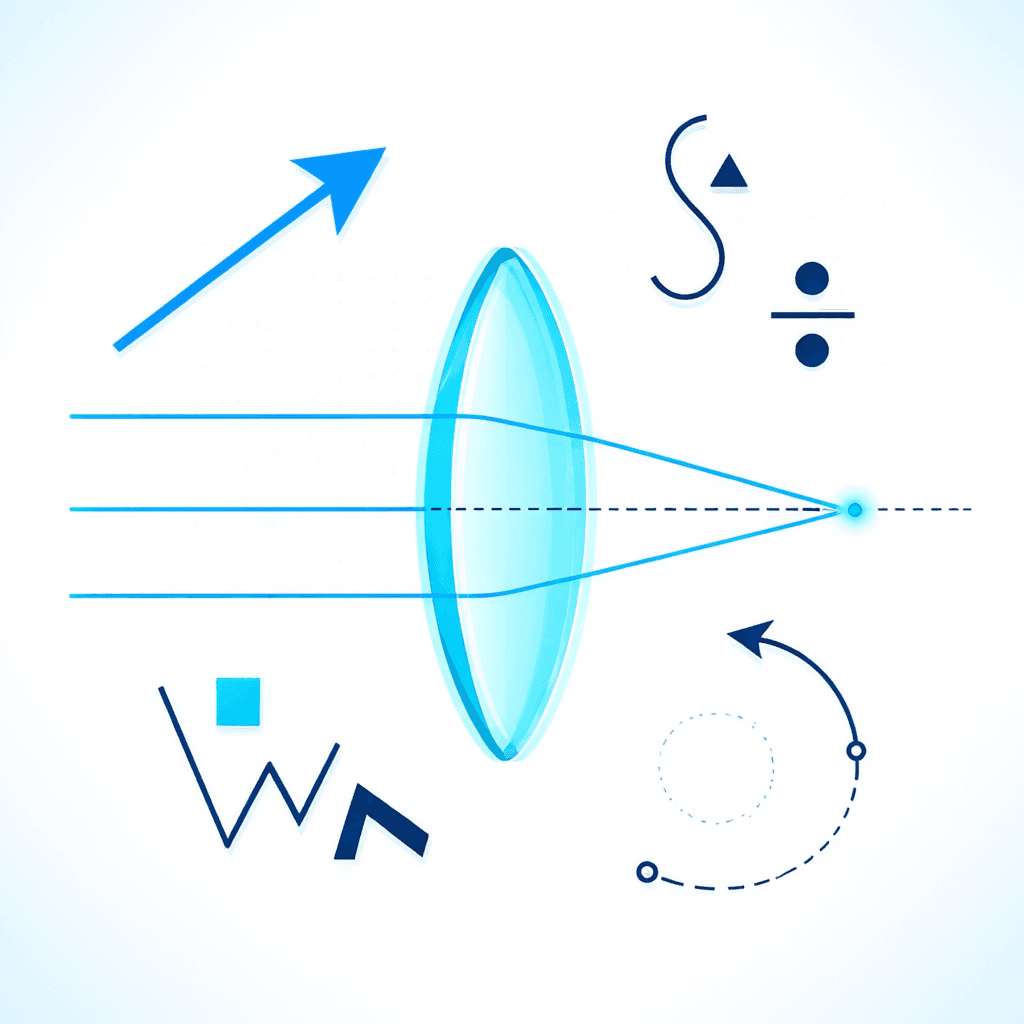
Optics deserves special attention. It is uniquely relevant to optometry, it always appears, and it is highly learnable: a short list of equations plus ray-diagram fluency covers nearly every question.
The Formula Strategy: About 30 Equations, Learned the Right Way
Formulas are not provided on the Optometry Admission Test. You must walk in with the core set memorized cold, including what each variable means and its units. Units are not decoration: they often hint at the solution path. If the answer needs meters per second and your formula produces seconds squared per meter, you grabbed the wrong equation before you did any math.
The wrong way to learn formulas is brute memorization. The right way is through problems:
- Annotate a formula sheet from day one. Every time a problem teaches you a formula, add it with units and a one-line use case.
- Write the formula before solving. Every problem, every time. Repetition through use is what makes recall automatic.
- Wean off the sheet by weeks 4 to 6. Cover it, write it from memory each morning, and check what you missed.
- Use the whiteboard brain dump. On test day, the 15-minute tutorial and the 30-minute break are your chance to rewrite your formula sheet from memory onto the provided whiteboard sheets.
The core set includes the kinematics equations, Newton's second law, work and kinetic energy relationships, momentum, torque, Hooke's law and oscillation period relationships, wave speed, pressure and buoyancy, heat and the first law of thermodynamics, Coulomb's law, Ohm's law and power in circuits, and the mirror and lens equations. Thirty equations, give or take. That is the whole mountain.
The Problem-Solving Method That Works Under Pressure
Top scorers do not derive physics on the exam. They recognize it. Three habits do the heavy lifting:
- Reverse engineering. Start from the question: what do I need to find X? Then: what do I need to get that? Chain backward until you land on values the problem gave you. This turns intimidating multi-concept questions into a shopping list.
- Free-body diagrams. For anything involving forces, draw the diagram before touching an equation. Free-body diagram fluency is the single most cited skill in high-scorer breakdowns.
- Pattern matching. One retaker described the breakthrough bluntly: stop trying to deeply understand, and start pattern-matching the question to the equation fast. That shift took them from fail-level to solidly average, enough for the sciences to carry the Total Science score. Deep understanding is a luxury for after you have banked the points.
Pacing: The 75-Second Rule
Fifty minutes for 40 questions works out to 75 seconds each. That is your entire timing strategy:
- Mark anything taking more than about a minute and move on. A marked question costs nothing; a five-minute spiral costs three other questions.
- Bank time on conceptual questions. Pure concept items take 20 to 30 seconds, which buys you two minutes for a one-step calculation later.
- Never leave a blank. There is no penalty for guessing, so every question gets an answer, even if it is a guess in the final seconds.
Screen lag between items is normal at Prometric, and the timer pauses while the next question loads. Do not let the lag rattle you.
Your Four-Week Physics Ramp Plan
This plan assumes physics is your weakest section and you are starting near zero. Fold it into your broader OAT study plan alongside the sciences.
- Week 1: Foundations. Units, vectors, linear kinematics, statics. Video lesson plus an immediate problem set each day. Start the annotated formula sheet. Draw a free-body diagram for every forces problem, no exceptions.
- Week 2: Mechanics core. Dynamics, energy and momentum, rotational motion. Begin timing your sets: 10 questions in 12 minutes. Keep annotating formulas through problems.
- Week 3: Oscillations, waves, fluids, thermal. Simple harmonic motion, waves, fluid statics, thermodynamics. End the week with your first full timed 40-question physics section.
- Week 4: Electricity and optics. Electrostatics, D.C. circuits, then optics hard. Take two more full timed sections. Write your formula sheet from memory every morning.
After week 4, physics shifts to maintenance: short daily formula reps and mixed timed sets inside full-length practice tests. If your course does not include representative full-lengths, that is a red flag, and our guide on choosing an OAT prep course explains why.
Real Exam vs. Practice Tests
Students consistently report the real physics section is more conceptual and more one-step than prep-course physics, and one 390 AA scorer said physics specifically felt more conceptual than expected. Representative practice tests track real scores within about 10 points, while non-representative material can sit 40 points or more below your real level and cause needless panic.
The takeaway: judge your readiness by your trend on representative tests, not by your worst day on an outdated one. Our OAT practice tests review covers how to tell the difference.
Our Recommendation
Physics is the lowest-scoring section nationally, which means every point you gain there separates you from more people than a point anywhere else. Learn the 30 formulas through problems, master free-body diagrams and reverse engineering, and enforce the 75-second rule. A good prep platform with representative physics sections and instant feedback on your misses will save you weeks of guessing. We've built ours around the exact methods that moved our own scores, but the principles work with any system that forces you to review every error.
That is the entire game.
Ready to crack the OAT?
Crack the OAT gives you 10 full-length practice tests, 10,000+ exam-style questions, 100+ hours of video crash courses, 50,000+ flashcards, and a complete study engine: Adaptive Quiz Generator, Adaptive Flashcard Generator, AI Tutor, Homework Helper, YouTube Summarizer, and Study Schedule Creator. Everything is aligned to the official OAT blueprint and comes with unlimited tokens, unlimited credits, no throttling, unlimited access, and unlimited usage. No subscriptions, no usage caps.
No credit card required for the free trial. One-time payment for full access.
Related articles
OAT Biology Review: High-Yield Topics for the Natural Sciences Section
On the Optometry Admission Test, biology opens the Survey of the Natural Sciences with questions 1 through 40, and it rewards breadth over depth. Here are the six domains and the active recall system that makes them stick.
Section GuidesOAT General Chemistry and Organic Chemistry Study Guide
The Optometry Admission Test packs 30 general chemistry and 30 organic chemistry questions into 90 minutes with no calculator. Here are the high-yield topics, the drill methods, and the pacing strategy for both halves.
Section GuidesOAT Reading Comprehension Strategy: Speed and Inference Tips
Three scientific passages, 50 questions, 60 minutes. Reading comprehension on the Optometry Admission Test (OAT) rewards a committed method, ruthless highlight discipline, and daily reading stamina, not natural speed.
Turn strategy into a top OAT score
10 full-length OAT tests, 10,000+ questions, 100+ hours of video, and unlimited AI tools. Start today.
Unlock Everything